February 6
One must not miss Banteay Srei.
This is among the most ancient of the temples in this area; a small and compact temple, situated some 35 kilometers from Siem Reap which takes over 2 hours in R’Ong’s slow tuk-tuk, so he got me to motodupe. It was fun. The temple is a masterpiece. I go mad taking in the exquisite panels, molted on terracotta panels that appear to cover every millimeter of this stunning building. I have never seen a work of art so exquisitely rendered. Unfortunately I go there at a time when everyone else also appear to have gone. So I have to wait an eternity to get a clean shot of any of the panels. So I switch to the 105mm tele; what a marvelous change. The intricate carvings jump into view with a freshness and immediacy that I was missing so far.
I am having a temple-fatigue. So I decide not to visit any more temple after Banteay Srei. It is the pinnacle after all.
On the way back we stop at the Siem Reap land mine museum. It is founded and own by an ex-Khmer Rouge child soldier, who was taken in at the age of seven after they killed his father and dispersed his mother. He learned to set booby trap mines for the Khmer Rouge at the age of seven, and became an expert in mines. He confesses to have maimed or killed hundreds, including innocent civilians, in fact at that time he had thought it to be almost a sport. At the age of nineteen, after slowing realizing the folly of the Khmer Rouge, he defected to the Vietnamese army, then became an office of the new Cambodian army, and ultimately was recruited by the UN to be trained as a de-mining expert, in which excelled. He then acted for many years as a trainer of UN de-mining teams himself. He claims to have removed hundreds of thousand mines, many of which he himself might have deployed in the past. Now retired, he runs this museum with his wife. The museum is a stark reminder of the machinations of war.
One statement stood out in the museum. Mines were developed to maim more than to kill, because a soldier killed is a soldier eliminated but a soldier maimed incurs more cost to the enemy in terms of attention to the maimed individual and resources needed to attend to the maimed soldier.
At least 30 countries still refuse to sign the international declaration not to develop and deploy mines any further. Among these countries are: USA, India, China and Russia. Most of the mines on display were manufactured or developed by the USA and the Soviet Union.
After a long trip back to the guest house, I freshen up, then take a walk to the Siem Reap’s famous tourist spot, the pub street, where I sit down with a glass of chilled draft and see the flow of international crowd past me. A German couple settles down beside me and begins to fight in German. Little do they suspect that their linguistic privacy is a mirage. A little later a couple from Manchester joins me and strikes up a conversation. They give a contact of a person in Phonm Penh, who does some volunteer stuff with street kids, and say he would be happy to have a helping hand for a day. We shall see. Sunset brings with a glorious sky and neon signs. I walk to the McDormet Gallery, where Sohrab had an exhibition last November, but now someone else’s photos are on display. Good work.
I go to a restaurant in The Alley and order an Amok. Delicious. But I remain hungry. Should have ordered a soup too, but too late. So I order a dessert. Dah….I get a bowl of daal cooked in sweet milk. I try to down it, but give up after a while. Return to the guest house and to bed. Tomorrow I go to R’Ong’s home.
Monday, February 9, 2009


The Grand Tour
February 5
The second day of temple hunting. I take the “grand tour” with R’Ong, after my usual breakfast of bread, cheese, banana, pineapple and coffee at the guesthouse. I meet an American woman of matronly proportion who sternly advises me on the importance of volunteering as a teaching in the English schools in Cambodia. She hasn’t done it yet but is looking forward to meeting a bunch of youth from various countries who are doing it now and apparently live in our guest house. I haven’t seen them either.
I forgot to write about the terrace of the Leper King which I saw yesterday at Angkor Thom. Misnamed, the terrace of the Leper King is not really dedicated to Jayavarmana I, who died of leprosy, but to Yama, the god of the underworld, is really the royal cremation site. Its terrace, walled so only one person can walk at a time, zig-zigs along the front of the sprawling compound. Light can only enter through the top, and in midday, when I walked through, is a tantalizing experience. The quality of light on the red sandstone gives an impression of a bleak desert cave, lit from the top, but its panels bristle with scenes from the wars of Mahabharata and other Hindu and Buddhist themes, carved on stone. Exquisitely crafted, they are complex; rows and rows of them along the wall in all their complexity and aloof beauty reminds me of what it must be like to see Petra, the dead city, though its resemblance to Petra is nonexistent.
But today on the grand tour, I go first to the temple of Ta Prohm, which is half engulfed by the seductive embrace of gigantic roots, which Lara Croft had graced once with her seductive escapades. In the temple I come across an old woman who tries to eke out a living by allowing worshipers to light an incense stick for a little change. I shoot her portraits instead of lighting incense; she is happy. She appears to be of an age that must have seen the French Indochine, Prince Norodom Sihanouk’s coronation as well as abdication to declare democracy in Cambodia, the rise of the rightist American stooge Lon Nol, whose complicity with the US led to Richard Nixon’s secret war—the carpet bombing of the Cambodian countryside to weed out the Viet Cong supply line, the coming of the Khmer Rouge and their genocidal madness of social engineering gone mad, the Vietnamese invasion of 1979, the civil war of the early nineties, followed by UN intervention and the rise of a teetering democracy. She is the first old person who I see in Cambdia face to face. I peer deeply into her eyes through my view finder, but these memories are veiled under an opacity that clouds her pupils.
The grand tour takes me to Phnom Bakheng, a magnificent 3-tiered pyramid where I huff and puff to the top and sit under a shade of the balustrade, through Preah Khan, a complex of temples where Buddhist themes intermingle with Hindu motifs in apparent confusion—distance from the origin appears to have melted the legends and philosophies into a single artistic expression that celebrates celestial dance more than remaining true to creed and scriptures, in the midday heat to the dry reservoir of Prasat (Prasad?) Neak Pean, a Buddhist shrine, then to the so-called Rolous group of temples that are some of the earliest of the Angkor temples. These latter temples are among the oldest, most of them built around 800AD to 1100AD, and these are distinctly different from the later temples of the Angkor complex that I had seen. Here the intricate carvings are more fluid and dynamic, the workmanship takes flight in sheer beauty, and the figurines are supremely dynamic. Most of these temples appear to be made from terracotta bricks, with the carvings molded into brick panels whereas the later Angkorean work is nearly exclusively carved on sandstone. The structures of these brick temples remind me of both the Stupa in Saranath as well as later terracotta brickworks of Bengal temples of the same time. Certainly Saranath predates the Rolous group by nearly 8 centuries. I am not sure if any of the Pallava architecture of the same time, made in terracotta bricks, has survived. The resemblance of Indian influence is so palpable that I feel certain that these Buddhist-Hindu temples represent more a direct adoption of Indian influence than an indirect one.
The day has been exhausting. The heat merciless. I stagger back to the guest house, take shower and eat a plain sour fish soup and crawl into bed.
The second day of temple hunting. I take the “grand tour” with R’Ong, after my usual breakfast of bread, cheese, banana, pineapple and coffee at the guesthouse. I meet an American woman of matronly proportion who sternly advises me on the importance of volunteering as a teaching in the English schools in Cambodia. She hasn’t done it yet but is looking forward to meeting a bunch of youth from various countries who are doing it now and apparently live in our guest house. I haven’t seen them either.
I forgot to write about the terrace of the Leper King which I saw yesterday at Angkor Thom. Misnamed, the terrace of the Leper King is not really dedicated to Jayavarmana I, who died of leprosy, but to Yama, the god of the underworld, is really the royal cremation site. Its terrace, walled so only one person can walk at a time, zig-zigs along the front of the sprawling compound. Light can only enter through the top, and in midday, when I walked through, is a tantalizing experience. The quality of light on the red sandstone gives an impression of a bleak desert cave, lit from the top, but its panels bristle with scenes from the wars of Mahabharata and other Hindu and Buddhist themes, carved on stone. Exquisitely crafted, they are complex; rows and rows of them along the wall in all their complexity and aloof beauty reminds me of what it must be like to see Petra, the dead city, though its resemblance to Petra is nonexistent.
But today on the grand tour, I go first to the temple of Ta Prohm, which is half engulfed by the seductive embrace of gigantic roots, which Lara Croft had graced once with her seductive escapades. In the temple I come across an old woman who tries to eke out a living by allowing worshipers to light an incense stick for a little change. I shoot her portraits instead of lighting incense; she is happy. She appears to be of an age that must have seen the French Indochine, Prince Norodom Sihanouk’s coronation as well as abdication to declare democracy in Cambodia, the rise of the rightist American stooge Lon Nol, whose complicity with the US led to Richard Nixon’s secret war—the carpet bombing of the Cambodian countryside to weed out the Viet Cong supply line, the coming of the Khmer Rouge and their genocidal madness of social engineering gone mad, the Vietnamese invasion of 1979, the civil war of the early nineties, followed by UN intervention and the rise of a teetering democracy. She is the first old person who I see in Cambdia face to face. I peer deeply into her eyes through my view finder, but these memories are veiled under an opacity that clouds her pupils.
The grand tour takes me to Phnom Bakheng, a magnificent 3-tiered pyramid where I huff and puff to the top and sit under a shade of the balustrade, through Preah Khan, a complex of temples where Buddhist themes intermingle with Hindu motifs in apparent confusion—distance from the origin appears to have melted the legends and philosophies into a single artistic expression that celebrates celestial dance more than remaining true to creed and scriptures, in the midday heat to the dry reservoir of Prasat (Prasad?) Neak Pean, a Buddhist shrine, then to the so-called Rolous group of temples that are some of the earliest of the Angkor temples. These latter temples are among the oldest, most of them built around 800AD to 1100AD, and these are distinctly different from the later temples of the Angkor complex that I had seen. Here the intricate carvings are more fluid and dynamic, the workmanship takes flight in sheer beauty, and the figurines are supremely dynamic. Most of these temples appear to be made from terracotta bricks, with the carvings molded into brick panels whereas the later Angkorean work is nearly exclusively carved on sandstone. The structures of these brick temples remind me of both the Stupa in Saranath as well as later terracotta brickworks of Bengal temples of the same time. Certainly Saranath predates the Rolous group by nearly 8 centuries. I am not sure if any of the Pallava architecture of the same time, made in terracotta bricks, has survived. The resemblance of Indian influence is so palpable that I feel certain that these Buddhist-Hindu temples represent more a direct adoption of Indian influence than an indirect one.
The day has been exhausting. The heat merciless. I stagger back to the guest house, take shower and eat a plain sour fish soup and crawl into bed.
At Angkor
February 4, 2009:
Last night I had a nice simple dinner of sour fish soup and rice. Typically Cambodian, I am told. Then to bed.
I wake at 6, up by 6:30, 50% rapid yoga, the standing poses only. Then to breakfast. Fruits, French bread, cheese, and black coffee. Then I am ready to go at 7:15. The tuk-tuk wallah is from the guest house. His name is R’ong, a twenty nine year old.
We leave behind the early morning bustle of Siem Reap in about 10 minutes, by 15 minutes we sail through a grand avenue lined with tall trees that remind me of old India, of its deciduous forests and blue sky, large leaves dusted lightly with a red dust.

Presently the tuk-tuk drives by a long moat, one that surrounds the main Angkor Wat temple area on all (?) sides. The tuk-tuk parks, and I step out to the expected throng of children who accosts you to buy something. Buy a water from me when you return, a girl instructs.

First shock is that a three-day pass is not $20 but $40. The daily pass is $20. Well, I am too committed to do anything now. So I get a three-day pass.
What can I write about the Angkor temples? It is a spectacle truly to be seen to believe.
In sheer size, area, grandeur, detail, complexity, the temple complex is just stunning, mind blowingly awesome. Imagine Palenque and multiply by a factor of 20 or 25. The preservation is terrible, yet whatever remains boggles the mind. Rows of walls curved with war scenes from the Mahabharata, another wall with Bodhisattva’s different incarnation’s escapades, another wall curved with war scenes from the times of Angkor king Jayavarmana VI. I see a total of eight massive temples today, with about five little additional ones thrown in here and there.
Having been familiar with the Pallava architecture of India, the founding colonizers of Angkor in 8th Century AD, I was particularly interested in finding out how much of the parent style remained. Some of the temples, the earlier ones are Hindu, appear to be reminiscent of the Pallava art in its fluid movement of its human images, in its simplicity of lines. Yet somewhere I see a more formal rendition. The height of the Pallavas is associated with exquisite naturalism and a brilliant ability to depict motion and weight in stone carvings. One remembers the rush of Durga, the Amazon goddess, wielding bows and arrows and other lethal weapons, towards the Asura, her arms supple, body in a liquid rush, her face that of a charming young woman whose lines of eyes and lips and the turn of her chin you can recognize readily among Southern Indian women of even today. That naturalism is gone, but its life though hidden is still palpable in the gentle curves and self-absorbed smiles, underneath a more solemn tempo of contemplative meter, a solemnity fittingly borne by a culture that arose from the depth of the tropical forest. And forest it is. Roots of massive trees that churn around the sand stone carvings in reptilian grace, which reflects the Angkor cultures obsession with snakes of the underworld, the Nagas, from which their kings had claimed to come. This legend is old: the Pallava kings had previously claimed the same. The later Buddhist temples are way more formal, but their Hindu ancestry is still palpable. Nags are everywhere.
I take photos like an obsessed man, forgetting his specialization that he does not take photos of inanimate objects.
He must rise to the occasion. His specialization can wait.
But to fall in love with a country is more than spectacular art.
It is to remember in deserted back alleys of ruined temples that are over a thousand years old, surrounded by forests of trees that speak only through the screeches of parakeets flying high on its branches. It is to remember the singsong tones as one exits each temple,
“Siiirrr, do you want wateeeee(r)
Only one dowwlaaa(r)
The thin childish voice rises and falls like a note breathed through a bamboo flute.
For lunch I buy two coconuts, two wrist-lets, a bamboo flute, and cut green sour mangoes with salt and chili, at various times from various urchins. And of course they have a great time pestering every one. Near the end of the day, one girl comes running, “Shirt for a million dowlaaa…, three for two dowlaa”, she breaks out giggling. I smile and ask what class does she study in, “Eight! See sir I just came after school so I did not sell anything yet, and the day is ending.” I smile and nod my head and go on. She turns around and dances away, singing a most beautiful tune under her breath. Among the trees hovering over the red soil and the falling sun it seems magical. Then I cross the street, and another one, even smaller and more cute, comes running, and asks me to buy a bangle from her, “Three for two dowlaaa…please buy one” she announces. I say I can’t. The little she-elf says, “No sir, you can but you don’t want to.” I laugh at this and say yes she is right. I don’t want to. She plays along, “three for one dowlaaa…three for zero dowlaaa…” At this I turn around smiling. She comes and gives me a little bangle, “this is for good luck, free for you” and turns around and walks away. I am stunned; I don’t know what to do. She then almost immediately catches a young man, a French, and gives him one, “Free for you sir” and runs away. The French guy is bewildered. He tries to run behind her and give it back, but she dodges him and runs away laughing. He looks at me sheepishly and says, “they are going to catch me on the way back, and sell $10 worth of stuff!”
On the way back, the sun is low on the horizon over the distant forest. The French man is at the back of a motorbike driven by a Cambodian (a motodupe, it is called, the cheapest transportation for foreigners in Siem Reap, which I am trying best to avoid). He waves at me in the tuk-tuk. What did you buy? He makes a zero sign and disappears.
I return limping. Whole body, particularly the lower portion, is leaden with aches. After a refreshing shower, R’ong takes me to a Cambodian food joint for the locals. Man, I could be violently ill tomorrow. The food is raw sea fish, beef, chicken, pork liver, and vegetable, which are cooked on the table over a steamer. The problem is not that, but unlike in America where they cook the whole thing together, here they add little by little with a pair of chopsticks these raw flesh and sea creatures, and with the same chopsticks they keep eating them as they are cooked, the uncooked juices no doubt mixing with cooked juices at various times in the chopsticks and little sauce dishes.
Tomorrow will tell. I am scheduled to leave at 7:30 AM for the next set of temples, this time a little far away. Wish me good luck. Certainly no more culinary adventure tomorrow even if I survive today’s with no incidence.
Last night I had a nice simple dinner of sour fish soup and rice. Typically Cambodian, I am told. Then to bed.
I wake at 6, up by 6:30, 50% rapid yoga, the standing poses only. Then to breakfast. Fruits, French bread, cheese, and black coffee. Then I am ready to go at 7:15. The tuk-tuk wallah is from the guest house. His name is R’ong, a twenty nine year old.
We leave behind the early morning bustle of Siem Reap in about 10 minutes, by 15 minutes we sail through a grand avenue lined with tall trees that remind me of old India, of its deciduous forests and blue sky, large leaves dusted lightly with a red dust.

Presently the tuk-tuk drives by a long moat, one that surrounds the main Angkor Wat temple area on all (?) sides. The tuk-tuk parks, and I step out to the expected throng of children who accosts you to buy something. Buy a water from me when you return, a girl instructs.

First shock is that a three-day pass is not $20 but $40. The daily pass is $20. Well, I am too committed to do anything now. So I get a three-day pass.
What can I write about the Angkor temples? It is a spectacle truly to be seen to believe.
In sheer size, area, grandeur, detail, complexity, the temple complex is just stunning, mind blowingly awesome. Imagine Palenque and multiply by a factor of 20 or 25. The preservation is terrible, yet whatever remains boggles the mind. Rows of walls curved with war scenes from the Mahabharata, another wall with Bodhisattva’s different incarnation’s escapades, another wall curved with war scenes from the times of Angkor king Jayavarmana VI. I see a total of eight massive temples today, with about five little additional ones thrown in here and there.
Having been familiar with the Pallava architecture of India, the founding colonizers of Angkor in 8th Century AD, I was particularly interested in finding out how much of the parent style remained. Some of the temples, the earlier ones are Hindu, appear to be reminiscent of the Pallava art in its fluid movement of its human images, in its simplicity of lines. Yet somewhere I see a more formal rendition. The height of the Pallavas is associated with exquisite naturalism and a brilliant ability to depict motion and weight in stone carvings. One remembers the rush of Durga, the Amazon goddess, wielding bows and arrows and other lethal weapons, towards the Asura, her arms supple, body in a liquid rush, her face that of a charming young woman whose lines of eyes and lips and the turn of her chin you can recognize readily among Southern Indian women of even today. That naturalism is gone, but its life though hidden is still palpable in the gentle curves and self-absorbed smiles, underneath a more solemn tempo of contemplative meter, a solemnity fittingly borne by a culture that arose from the depth of the tropical forest. And forest it is. Roots of massive trees that churn around the sand stone carvings in reptilian grace, which reflects the Angkor cultures obsession with snakes of the underworld, the Nagas, from which their kings had claimed to come. This legend is old: the Pallava kings had previously claimed the same. The later Buddhist temples are way more formal, but their Hindu ancestry is still palpable. Nags are everywhere.
I take photos like an obsessed man, forgetting his specialization that he does not take photos of inanimate objects.
He must rise to the occasion. His specialization can wait.
But to fall in love with a country is more than spectacular art.
It is to remember in deserted back alleys of ruined temples that are over a thousand years old, surrounded by forests of trees that speak only through the screeches of parakeets flying high on its branches. It is to remember the singsong tones as one exits each temple,
“Siiirrr, do you want wateeeee(r)
Only one dowwlaaa(r)
The thin childish voice rises and falls like a note breathed through a bamboo flute.
For lunch I buy two coconuts, two wrist-lets, a bamboo flute, and cut green sour mangoes with salt and chili, at various times from various urchins. And of course they have a great time pestering every one. Near the end of the day, one girl comes running, “Shirt for a million dowlaaa…, three for two dowlaa”, she breaks out giggling. I smile and ask what class does she study in, “Eight! See sir I just came after school so I did not sell anything yet, and the day is ending.” I smile and nod my head and go on. She turns around and dances away, singing a most beautiful tune under her breath. Among the trees hovering over the red soil and the falling sun it seems magical. Then I cross the street, and another one, even smaller and more cute, comes running, and asks me to buy a bangle from her, “Three for two dowlaaa…please buy one” she announces. I say I can’t. The little she-elf says, “No sir, you can but you don’t want to.” I laugh at this and say yes she is right. I don’t want to. She plays along, “three for one dowlaaa…three for zero dowlaaa…” At this I turn around smiling. She comes and gives me a little bangle, “this is for good luck, free for you” and turns around and walks away. I am stunned; I don’t know what to do. She then almost immediately catches a young man, a French, and gives him one, “Free for you sir” and runs away. The French guy is bewildered. He tries to run behind her and give it back, but she dodges him and runs away laughing. He looks at me sheepishly and says, “they are going to catch me on the way back, and sell $10 worth of stuff!”
On the way back, the sun is low on the horizon over the distant forest. The French man is at the back of a motorbike driven by a Cambodian (a motodupe, it is called, the cheapest transportation for foreigners in Siem Reap, which I am trying best to avoid). He waves at me in the tuk-tuk. What did you buy? He makes a zero sign and disappears.
I return limping. Whole body, particularly the lower portion, is leaden with aches. After a refreshing shower, R’ong takes me to a Cambodian food joint for the locals. Man, I could be violently ill tomorrow. The food is raw sea fish, beef, chicken, pork liver, and vegetable, which are cooked on the table over a steamer. The problem is not that, but unlike in America where they cook the whole thing together, here they add little by little with a pair of chopsticks these raw flesh and sea creatures, and with the same chopsticks they keep eating them as they are cooked, the uncooked juices no doubt mixing with cooked juices at various times in the chopsticks and little sauce dishes.
Tomorrow will tell. I am scheduled to leave at 7:30 AM for the next set of temples, this time a little far away. Wish me good luck. Certainly no more culinary adventure tomorrow even if I survive today’s with no incidence.
From Bangkok to Siem Reap
February 3, 2009:
After a fitful night in which I had left the tv on cnn, volume down, so I won't sleep through, I woke with a start at 5:40am. The driver was supposed to come at 6:45, and I had asked the front desk to give me a wake up call at 5am. There was no wake up call.
I rushed to the shower, quickly packed, and sat down to send a last email, then the phone rang. The driver was here. 10 min, I said.
I was out the door in 10 minutes more. Then I realized that I had left my watch hands an unknown amount of time.
I leave my big bag at the front desk while a young fellow tries to take it from there and bring it down to the taxi. I try to explain but in vain. At last the front desk tells him to keep it there--they will put it in the storage.
It was a scary drive, at over 130 km/h in 80 km/h speed zones, no seat belt. The driver is impressed I am off to 'Kampuchea'!
He leaves me at the North Station. The Information desk asks me to go down to number 30 stall. I purchase a one way A/C ticket to Aranyer Prathet and ask for a window seat. The woman smiles and tells me to go to dock 30. The bus is loading. I cram my backpack into the hold and climb up. Some people are on my seat, so I show them my ticket. An Irish man in his late twenties and a young NZ lass of hardly 18; I would be surprised if she is even that. They realize now the markings are on the back of the previous seats, not on their own seats. I settle down and watch whether the backpack remains in the hold.
We start in a few minutes. Nondescript urban sprawl of the megalopolis yawns and stretches under the dusty morning sky. Soon there is a lollypop red sunrise. I have no one beside me so I tuck my legs in and relax.
Leaving Bangkok on the eastern highway, crawling towards the border, the bus stops at various points on the way. A woman with a cute faced baby comes in a sits down beside me. I tickle the baby and he laughs and shrieks ecstatically. The whole family, with a toddler brother takes part in the melee.
My seat becomes vacant. After some three hours through the countryside, with waterways laden with pink lotus and white lilies, rows of trees denuded of foliage but overflowing with beautiful golden flowers, the soil slowly turns a ruddy red. The bus enters the border town and evacuates us in the middle of a bustling market. I try to pull the backpack on myself, but a crowd of tuk-tuk wallahs tries to get a business. I spy that the Irish-nz couple takes a tuk-tuk, so I jump on one--80 bhats, he says and points to the board on the road. That seems fine. The tuk-tuk speeds along for ~2 km, then suddenly takes a left turn. I know something is up, because the irish-nz couple went straight. At the turn is a little resting place and a travel agency, where the tuk-tuk stops and a man tries to sell me Cambodian visa for $30. I say that it costs only $20 at the border, but he pushes me, saying in the border it is only a stamp. I remain unmoved. I see three girls and a young man already in the shed, filling out forms. Then the tuk-tuk wallah takes me to a building labeled "Cambodian Consulate", where I go in and two people hand me a visa application form and assist me fill it. I take it to the counter, where an official looking man asks for $30. I refuse. He says $20 if I get it at the embassy in the US. I then ask for a receipt, and he says he does not give a receipt. So I walk out, and ask the tuk-tuk to take me to the border. He smiles and takes me this time to the border.
At the border, after a short walk from the tuk-tuk stop, I see a brief line for foreigners and a huge long line for Thai nationals. Just ahead of me are the three girls and the young man. I ask them about whether they purchased the visa already. They had, and had paid $30 each plus they got a taxi that will pick them up beyond the border for $50 each. I confess that I had not got the visa, so might have to return after all. They wanted to know where was my information, and I show them my Lonely Planet 2007 edition. They appear to have an older edition, 2004, which did not tell them that they issue visa at the border itself and did not warn them of a scam. Let's see what happens next.
A woman came out and started shouting in a shrill voice, and some 40 Thai nationals surged through into Thai departure area. This happened some five times before the time of the foreigners came. The room was air conditioned, which was a welcome relief. I learned that the young man has just graduated from college and is now traveling throughout Asia for seven months before going to job. I tell him good idea, with the job market in this way. He says he already has a job...a graduate fellowship to do PhD in philosophy. He asked me what I do, and upon learning he brightened up. He apparently did an undergraduate in molecular biology, then did a two year MS in philosophy. He asked me to explain my research, which I did standing in the line. He was reading the new Dawkins book on the God hypothesis, and we began to discuss agnosticism versus atheism...he was being cautious earlier but now after reading Dawkins he confessed to having become an atheist. He would do his thesis on "trans-human"---when mechanical technology interfaces with human biologically, where does a human being end and a machine begin? Of course it does not exist yet, but the time will come, and he wants to explore those issues and ethical questions surrounding them.
Passage through Thai departure area was a breeze because of the conversations. As I emerged in the heat, I see a dusty, seedy border town, run amok with cattle, goats, street urchins, push carts, tuk-tuks, taxis and shop stalls. I walk determinedly ahead, knowing nothing where to go yet giving the impression that I have been through this all many times before. I soon pass the three girls and the man, trying to board a taxi that apparently was waiting for them. I see from a distance a little office labeled, "visa". I go in there, fill up a short form, and give them a passport photo and $20. Two minutes and done. I take it down another 300 meters, where I fill in another form, and get the visa stamped in the passport. As I stand in the line I see the same Irish-nz couple ahead of me. I ask whether they are going to Siem Reap. They say no, they will return to Bangkok today. I do not ask what the hell they were doing here, out of politeness. They ask whether I booked my taxi, and say it will be a bumpy ride to Siem Reap. I confess that I haven't figured that part yet. A woman in late fifties, obviously cockney, who is on the parallel line tells me that that's where she is going too, and whether I would like to share. I am relieved. She says her boyfriend is a Cambodian, who is going with her, and the three of us can share the fare. Sure thing. The boyfriend arrives. Pierre is a polite Cambodian (do they make a rude Cambodian? Not yet. Who knows) with a young face, hardly 35. We stuff our packs/bags in. I move to the front, they take the back. I ask whether shops here take small bhats because I lost my water bottle. The woman offers a bottle that she has extra. We pay $10 each to the middleman who had arranged the taxi and we will pay $14 each to the driver when we reach Siem Reap. Considering that the book says it should cost $40-50 to Siem Reap this sounds like a really good deal. The toyota has a very comfy front seat. We bump along violently and relentlessly through the dusty straight as an arrow road where every km or so there is small bridge being built so we take a little diversion around it.
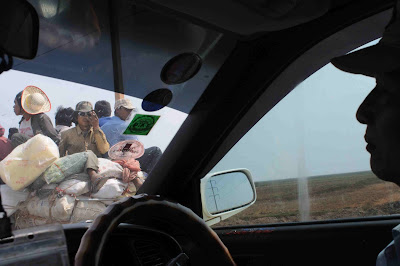

The terrain changes from rice paddies to the horizon, to palm groves. In three hours we reach Siem Reap and my "guest house". A wonderfully kept garden house overflowing with bougainvillea, low wicker chairs, a very polite young man who explained to me about visiting Angkor and other temples. He shows me to the room. Neat and simple, no frill but comfy. I take a quick shower. The man brings me a glass of welcome drink: a banana shake. I drink, read a book about Angkor that I find in the drawer and dose off to sleep.
It is dark when I awake. Nearly 7PM. I go out of my room, and against the lobby is an internet access place. 1000r per hour, which comes to some $0.25. So here I am, hammering away at my laptop.
Tomorrow at 7:30 I go to Angkor. Per day it is ~$12 by tuk-tuk, plus a three day pass of Angkor for $20.
I am hungry. I will now go out see what gives.
After a fitful night in which I had left the tv on cnn, volume down, so I won't sleep through, I woke with a start at 5:40am. The driver was supposed to come at 6:45, and I had asked the front desk to give me a wake up call at 5am. There was no wake up call.
I rushed to the shower, quickly packed, and sat down to send a last email, then the phone rang. The driver was here. 10 min, I said.
I was out the door in 10 minutes more. Then I realized that I had left my watch hands an unknown amount of time.
I leave my big bag at the front desk while a young fellow tries to take it from there and bring it down to the taxi. I try to explain but in vain. At last the front desk tells him to keep it there--they will put it in the storage.
It was a scary drive, at over 130 km/h in 80 km/h speed zones, no seat belt. The driver is impressed I am off to 'Kampuchea'!
He leaves me at the North Station. The Information desk asks me to go down to number 30 stall. I purchase a one way A/C ticket to Aranyer Prathet and ask for a window seat. The woman smiles and tells me to go to dock 30. The bus is loading. I cram my backpack into the hold and climb up. Some people are on my seat, so I show them my ticket. An Irish man in his late twenties and a young NZ lass of hardly 18; I would be surprised if she is even that. They realize now the markings are on the back of the previous seats, not on their own seats. I settle down and watch whether the backpack remains in the hold.
We start in a few minutes. Nondescript urban sprawl of the megalopolis yawns and stretches under the dusty morning sky. Soon there is a lollypop red sunrise. I have no one beside me so I tuck my legs in and relax.
Leaving Bangkok on the eastern highway, crawling towards the border, the bus stops at various points on the way. A woman with a cute faced baby comes in a sits down beside me. I tickle the baby and he laughs and shrieks ecstatically. The whole family, with a toddler brother takes part in the melee.
My seat becomes vacant. After some three hours through the countryside, with waterways laden with pink lotus and white lilies, rows of trees denuded of foliage but overflowing with beautiful golden flowers, the soil slowly turns a ruddy red. The bus enters the border town and evacuates us in the middle of a bustling market. I try to pull the backpack on myself, but a crowd of tuk-tuk wallahs tries to get a business. I spy that the Irish-nz couple takes a tuk-tuk, so I jump on one--80 bhats, he says and points to the board on the road. That seems fine. The tuk-tuk speeds along for ~2 km, then suddenly takes a left turn. I know something is up, because the irish-nz couple went straight. At the turn is a little resting place and a travel agency, where the tuk-tuk stops and a man tries to sell me Cambodian visa for $30. I say that it costs only $20 at the border, but he pushes me, saying in the border it is only a stamp. I remain unmoved. I see three girls and a young man already in the shed, filling out forms. Then the tuk-tuk wallah takes me to a building labeled "Cambodian Consulate", where I go in and two people hand me a visa application form and assist me fill it. I take it to the counter, where an official looking man asks for $30. I refuse. He says $20 if I get it at the embassy in the US. I then ask for a receipt, and he says he does not give a receipt. So I walk out, and ask the tuk-tuk to take me to the border. He smiles and takes me this time to the border.
At the border, after a short walk from the tuk-tuk stop, I see a brief line for foreigners and a huge long line for Thai nationals. Just ahead of me are the three girls and the young man. I ask them about whether they purchased the visa already. They had, and had paid $30 each plus they got a taxi that will pick them up beyond the border for $50 each. I confess that I had not got the visa, so might have to return after all. They wanted to know where was my information, and I show them my Lonely Planet 2007 edition. They appear to have an older edition, 2004, which did not tell them that they issue visa at the border itself and did not warn them of a scam. Let's see what happens next.
A woman came out and started shouting in a shrill voice, and some 40 Thai nationals surged through into Thai departure area. This happened some five times before the time of the foreigners came. The room was air conditioned, which was a welcome relief. I learned that the young man has just graduated from college and is now traveling throughout Asia for seven months before going to job. I tell him good idea, with the job market in this way. He says he already has a job...a graduate fellowship to do PhD in philosophy. He asked me what I do, and upon learning he brightened up. He apparently did an undergraduate in molecular biology, then did a two year MS in philosophy. He asked me to explain my research, which I did standing in the line. He was reading the new Dawkins book on the God hypothesis, and we began to discuss agnosticism versus atheism...he was being cautious earlier but now after reading Dawkins he confessed to having become an atheist. He would do his thesis on "trans-human"---when mechanical technology interfaces with human biologically, where does a human being end and a machine begin? Of course it does not exist yet, but the time will come, and he wants to explore those issues and ethical questions surrounding them.
Passage through Thai departure area was a breeze because of the conversations. As I emerged in the heat, I see a dusty, seedy border town, run amok with cattle, goats, street urchins, push carts, tuk-tuks, taxis and shop stalls. I walk determinedly ahead, knowing nothing where to go yet giving the impression that I have been through this all many times before. I soon pass the three girls and the man, trying to board a taxi that apparently was waiting for them. I see from a distance a little office labeled, "visa". I go in there, fill up a short form, and give them a passport photo and $20. Two minutes and done. I take it down another 300 meters, where I fill in another form, and get the visa stamped in the passport. As I stand in the line I see the same Irish-nz couple ahead of me. I ask whether they are going to Siem Reap. They say no, they will return to Bangkok today. I do not ask what the hell they were doing here, out of politeness. They ask whether I booked my taxi, and say it will be a bumpy ride to Siem Reap. I confess that I haven't figured that part yet. A woman in late fifties, obviously cockney, who is on the parallel line tells me that that's where she is going too, and whether I would like to share. I am relieved. She says her boyfriend is a Cambodian, who is going with her, and the three of us can share the fare. Sure thing. The boyfriend arrives. Pierre is a polite Cambodian (do they make a rude Cambodian? Not yet. Who knows) with a young face, hardly 35. We stuff our packs/bags in. I move to the front, they take the back. I ask whether shops here take small bhats because I lost my water bottle. The woman offers a bottle that she has extra. We pay $10 each to the middleman who had arranged the taxi and we will pay $14 each to the driver when we reach Siem Reap. Considering that the book says it should cost $40-50 to Siem Reap this sounds like a really good deal. The toyota has a very comfy front seat. We bump along violently and relentlessly through the dusty straight as an arrow road where every km or so there is small bridge being built so we take a little diversion around it.


The terrain changes from rice paddies to the horizon, to palm groves. In three hours we reach Siem Reap and my "guest house". A wonderfully kept garden house overflowing with bougainvillea, low wicker chairs, a very polite young man who explained to me about visiting Angkor and other temples. He shows me to the room. Neat and simple, no frill but comfy. I take a quick shower. The man brings me a glass of welcome drink: a banana shake. I drink, read a book about Angkor that I find in the drawer and dose off to sleep.
It is dark when I awake. Nearly 7PM. I go out of my room, and against the lobby is an internet access place. 1000r per hour, which comes to some $0.25. So here I am, hammering away at my laptop.
Tomorrow at 7:30 I go to Angkor. Per day it is ~$12 by tuk-tuk, plus a three day pass of Angkor for $20.
I am hungry. I will now go out see what gives.
Subscribe to:
Posts (Atom)